


About Us
Advances in quantum technology offer new perspectives in computing, networking, information processing, and AI-based decision making, while also imposing new cybersecurity threats to our society. We presume that powerful quantum computers will be constructed in the (near?) future, which can perform certain types of computational tasks more efficiently (i.e., requiring less time or less energy) than classical ones. On the one hand, this is clearly a positive achievement bringing new opportunities to optimization, drug discovery, scientific computing, etc. On the other hand, it also forces us to redesign our cryptographic toolset, to ensure that data protected today will not be easily undisclosed by the computers of the quantum era.
The research group addresses both sides by studying quantum(-enhanced) algorithms, and by investigating how, and for what purposes, quantum computers could be used. Furthermore, we also focus on designing secure communication and cryptographic protocols, as well as on developing secure and universal software components for Quantum Communication Infrastructure (QCI) frameworks to address the Quantum Threat. The research group closely collaborates with the Department of Programming Languages and Compilers, the Department of Computer Algebra, and the Faculty of Science.
Research Interests
▶ Quantum computing
- photonic quantum computing (e.g., boson sampling)
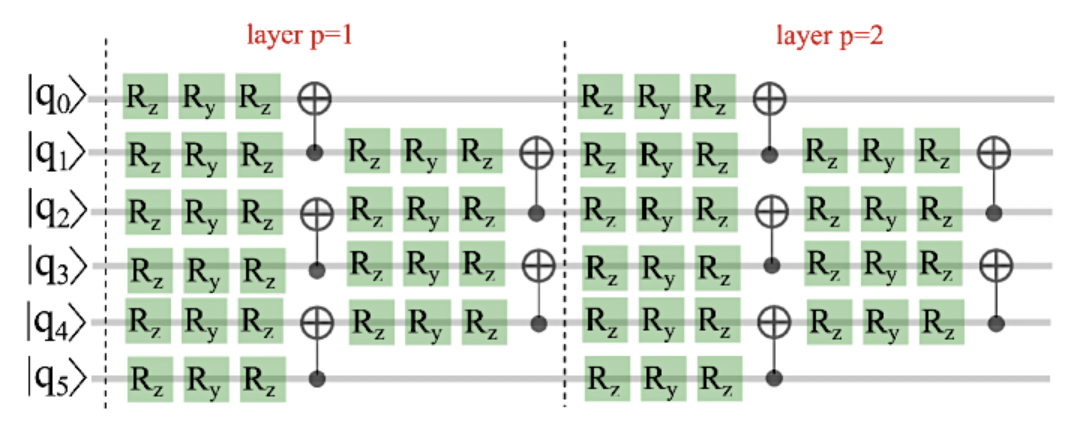
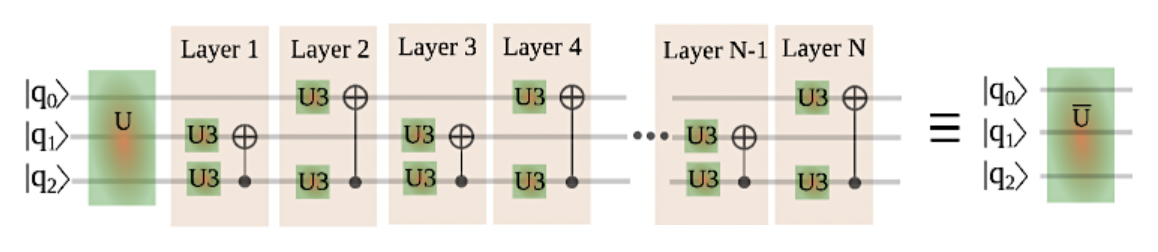
- quantum gate decompositions
- quantum algorithms and optimization methods
- quantum machine learning (ML for quantum systems and on quantum computers)
- unitary designs
- quantum computer emulation and use of accelerator technologies for simulations
- development of a qubit-based programming language (Qubla)
- hardware security modules for quantum cloud computing
- applications of artificial intelligence and software-defined networking (SDN) in quantum projects
Related publications:
☞ Batched line search strategy for navigating through Barren plateaus in quantum circuit training
☞ Approaching the theoretical limit in quantum gate decomposition
☞ Highly optimized quantum circuits synthesized via data-flow engines
☞ Prog-QAOA: Framework for resource-efficient quantum optimization through classical programs
☞ Quantum-classical autoencoder architectures for end-to-end radio communication
☞ Hybrid quantum-classical reinforcement learning in latent observation spaces
☞ Hybrid quantum-classical autoencoders for end-to-end radio communication
☞ Problem-informed graphical quantum generative learning
▶ Quantum cryptography and quantum communication infrastructures
- protocol design
- QKD standards
- secure quantum communication
▶ Post-quantum cryptography
- isogeny-based schemes
- cryptanalysis
Research Methodology
- Designing programming languages for qubit-based and qumode-based computing.
- Development of compilers, code optimizers, gate decomposers (SQUANDER) and simulation environments (Piquasso) for quantum computing.
- Performance improvement of simulators with accelerator-based backends (e.g., FPGA).
- Setting up a small-scale photonic quantum computer for experimentation.
- Development of new quantum-safe cryptography schemes.
- Analysis of existing PQC-schemes for vulnerabilities.
Research Staff
- Tamás Kozsik (research group leader, bibliography: MTMT)
- Zoltán Zimborás (ELTE Faculty of Sciences)
- Péter Rakyta (ELTE Faculty of Sciences)
- Péter Kutas
- Péter Burcsi
- Péter Ligeti
- Antal Száva
- Szabolcs Jóczik
- Zoltán Kolarovszki (PhD candidate)
- Bence Bakó (PhD student)
- Ágoston Kaposi (PhD student)
- Gergely Gálfi (PhD student)
- Gregory Reynolds Morse (PhD student)
- Zoltán Kégli (PhD student)
- and students
Projects
- Quantum Information National Laboratory of Hungary
- Deploy Advanced Quantum Communication Infrastructure in Hungary (Digital Europe Programme)
- Machine Learning for Quantum (HORIZON-MSCA)
- Hardware Security Module for secure delegated Quantum Cloud Computing (QuantERA)
- MaCro: Mathematics for post-quantum cryptanalysis (CELSA)
- Herausforderungen in der Hardware-Implementirerung von Isogenie-basierten Protokollen
Key Publications
- G. Morse, T. Rybotycki, Á. Kaposi, Z. Kolarovszki, U. Stojčić, T. Kozsik, O. Mencer, M. Oszmaniec, Z. Zimborás, P. Rakyta (2024): High performance Boson sampling simulation via data-flow engines, New Journal of Physics [DOI]
- I. A. Seres, Z. Horváth, P. Burcsi: The Legendre pseudorandom function as a multivariate quadratic cryptosystem: security and applications (2023), AAECC [DOI]
- Á. Kaposi, Z. Kolarovszki, A. Solymos, T. Kozsik, Z. Zimborás (2023): Constructing generalized unitary group designs, International Conference on Computational Science [DOI]
- Zs. I. Tabi, A. Marosits, Zs. Kallus, P. Vaderna, I. Gódor, Z. Zimborás (2021): Evaluation of quantum annealer performance via the massive MIMO problem, IEEE Access [DOI]
- L. De Feo, C. Delpech de Saint Guilhem, T. B. Fouotsa, P. Kutas, A. Leroux, C. Petit, J. Silva, B. Wesolowski (2021): Séta: Supersingular encryption from torsion attacks, International conference on the theory and application of cryptology and information security [DOI]
- Zs. Tabi, K. H. El-Safty, Z. Kallus, P. Hága, T. Kozsik, A. Glos, Z. Zimborás (2020): Quantum optimization for the graph coloring problem with space-efficient embedding, IEEE International Conference on Quantum Computing and Engineering [DOI]
Contact
Tamás Kozsik – tamas.kozsik@elte.hu